
How to Choose a Shamanic Drum? A Beginner's Guide
How to choose a shamanic drum? First of all, it is worth understanding that this is not just a beautiful and exotic attribute - it is a full-fledged musical instrument, so it should be chosen based on specific parameters. Different drums sound and „feel“ differently: size, membrane type, frame depth, stick and even the humidity of the house can change the sound and response. If the goal is meditation, rhythmic journey, sound practices or circle meetings, it is these details that determine whether the drum will become an everyday tool or remain just a decoration.
You can view examples of classic shamanic drums and different models here. samanasanto.lt in the e-shop, in the category "shamanic drums" (shamanic drums).
For what purpose do you choose a shamanic drum?
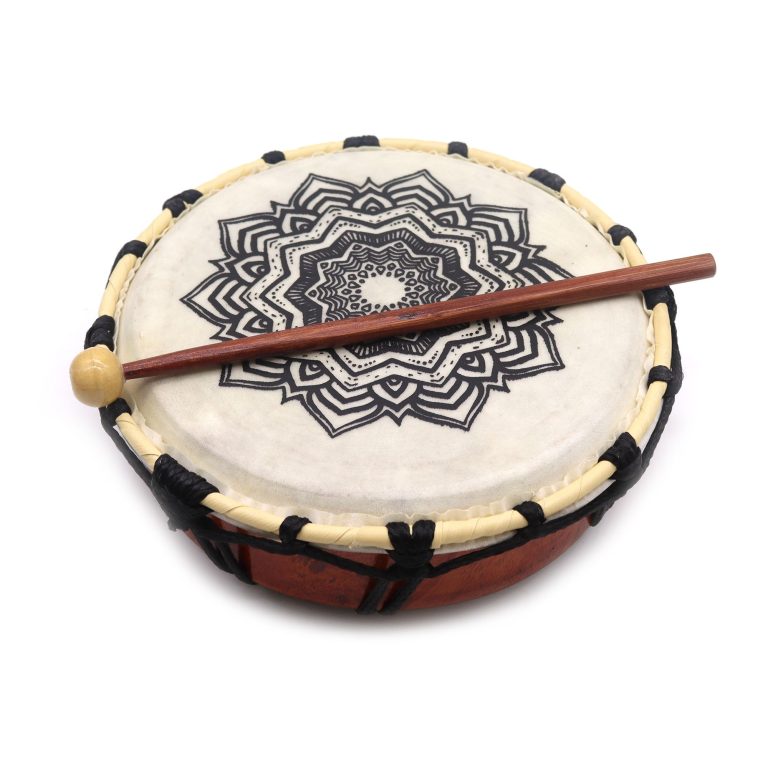
The shamanic drum is usually a frame drum: a wooden frame and a taut membrane that vibrates to create a monotonous, engaging pulse (Encyclopaedia Britannica: Frame drum). When choosing a shamanic drum, it is first worth answering the question, What will you use it for?. It is this decision that most likely "cuts out" the majority of unsuitable options and allows you to make a targeted choice: when it is clear whether the drum will be used for meditation, rhythmic journeying, sound practices or circle meetings, the choice of suitable shamanic drums immediately narrows down:
- For meditation and routine 35–45 cm drums are usually more comfortable;
- In circles/sound practices 45–55+ cm are often chosen for deeper „bass“;
- For travel comfortable 20–35 cm (compact).
What size shamanic drum is best for a beginner?
The most versatile shamanic drum is usually 40–45 cm, with a sufficiently deep sound, but easy to store and transport. It is offered to choose from the following size options:
- 20–30 cm: light, fast, for travel;
- 35–45 cm: balanced, for beginners;
- 50–55+ cm: powerful, but heavier and requires more control.
What is the difference between a drum head and how does it change the sound?
The membrane (skin) of a shamanic drum is the main element that determines the sound of the drum. Therefore, consider that:
- Genuine leather often sounds warmer, more organic, but is more sensitive to humidity and dry heating;
- Synthetic membrane usually more stable to climate, but the sound may be "tidyer", less "alive" (a matter of taste);
- Thinner skin – more sensitive attack; thicker – a stronger, deeper tone.
The sound of membrane instruments comes from the vibrating membrane (Encyclopaedia Britannica: Membranophone).
What does the frame, depth, and handle of a Shamanic Drum mean – or is it just convenience?
No – the design of a shamanic drum affects the resonance and sense of vibration, and holding directly determines whether the drum will be "comfortable" for longer practices:
- Deeper frame more often provides more "body" and projection;
- Comfortable handle/holding reduces tension in the wrist;
- Frame drums have historically had many different holding and playing traditions (Encyclopaedia Britannica: Drum).
How to choose a Shamanic drum stick (beater) so that the sound is "yours"?
The same drum with a different stick can sound completely different, so the beater is half of the instrument:
- Softer rod head – rounder, softer tone;
- Harder rod head – more pronounced attack and „click“;
- Longer stick more comfortable on wheels, shorter – for accuracy at home.
If it is important to have different shades in one practice, sets with 2 sticks are useful (samanasanto.lt: shaman drum with two sticks).
Do the symbolism and drawings on the drum have a meaning, or is it just aesthetics?
Symbolism can be both aesthetic and intentional, but historically drums often had decoration and markings. Examples of how instruments and their decoration are reflected in museum collections can be found in institutional catalogs (The Metropolitan Museum of Art: Drum (collection example)).
Shamanic Drum Selection Chart: Quick Comparison
| Need | Recommended size | Call direction | Who is most suitable for |
|---|---|---|---|
| Daily meditation at home | 35–45 cm | Balanced, easy to control | For beginners, routine |
| Circles/sound practices | 45–55+ cm | Deeper, "bodily" pulse | For groups, longer sessions |
| Travel, ceremonies | 20–35 cm | Fast response, compact | For mobility |
| „"Wave" effect (ocean drum) | ~30cm | Gentle, ambient | For sleep, relaxation |
If you are interested in an "ocean" type drum, it is a separate category with a specific effect (samanasanto.lt: Shaman Drum "Ocean"„).
Conclusions
When choosing a shamanic drum, it is most important to start with the purpose, as it determines the size, sound and comfort. For a universal start, 40–45 cm is usually suitable, as it is a balance between depth and control. The type of membrane, frame construction and stick really change the sound, so it is worth considering the set as a whole. In the Lithuanian climate, maintenance during the heating season is especially important to ensure that the drum remains stable.
If you are looking for a reliable option in Lithuania, check out samanasanto.lt shamanic drums and choose according to your purpose.
FAQ
What size shamanic drum is best for a beginner?
Often the most versatile choice for a beginner is 40–45 cm, because such a drum maintains a deep pulse, but is still convenient to store and transport. Smaller ones (20-35 cm) are more suitable for travel, while larger ones (50-55+ cm) provide more power, but require more control.
Is a natural leather shamanic drum better than a synthetic membrane?
Natural skin often provides a "warmer" and more organic sound, but is more sensitive to humidity and temperature changes. Synthetic membranes are generally more stable in everyday use, so they may be more comfortable if you will be transporting the drum frequently or storing it in rooms with dehumidifying heating.
How do you know if a shamanic drum is suitable for meditation and rhythmic journeying?
Most searched for meditation and rhythmic journey a steady, monotonous pulse and comfortable to hold. A good sign is when you can easily maintain a consistent rhythm without any tension in your wrist, and the drum doesn't "run away" from your hand. In practice, this often means an average size (35–45 cm) and a stick that is comfortable for you.
Is the stick (beater) really that important when choosing a shamanic drum?
Yes, a stick can make a big difference in sound and feel. A softer head will often produce a softer, rounder tone, while a harder head will produce a sharper attack. If possible, it's a good idea to get a set with a proper beater, or have 2 different ones so you can vary the sound as you practice.
Do the symbols on a shamanic drum have real meaning?
Symbolism can be meaningful as an intention and personal connection to the instrument, but the most important thing in choosing is that the visuals do not interfere with concentration. When in doubt, a safe bet is to go with a minimalist design and focus on sound, size, and comfort.
Where in Lithuania can I view examples of shamanic drums before choosing?
It's convenient to start with a clearly classified category and compare sizes and configurations. You can view examples samanasanto.lt in the category "Shamanic Drums" (samanasanto.lt: Shamanic drums).